Much of the conventional wisdom about investing has been predicated around the notion that purchasing indices of risky asset classes are optimal and provide the best way to generate a return over the long term. Such wisdom became common place and moved mainstream during the 1980's and 1990's and was further supported by academic theories. The widely held belief was that markets are efficient and indexing to benchmarks always provide the greatest return for a given amount of risk. The other notion has been that over the long term, risky assets will always perform better than safe assets like government bonds. Therefore, simple diversification and occasional rebalancing would be the way to manage risk in an otherwise passive portfolio. If it worked in the past, we can extrapolate into the future, so the theory goes.
These days, there is much discussion about the implications of such conventional wisdom. The new reality in today's markets and economy can be stated as anything but conventional. A series of bubbles and crashes have generated high volatility in both the markets and economy, with little or no gains for well over a decade. At the same time, safe investments have outperformed riskier ones. The ultimate question is whether the financial crisis was just a perfect storm of events and eventually the markets will revert back to expected long-term return rates, or if we are entering a cycle where high volatility, high asset class correlation, and lower expected returns will be the norm. And if we have entered a new cycle, how long may it last? What will be the impact on the conventional wisdom should this new reality prove to be true?
If we look back in history there are long periods of time with high volatility and sub par returns - 1930's into early 40's, mid 1960's into late 70's, and the year 2000 until now. The bursting of asset bubbles, especially when induced via credit expansion, are usually followed by periods of higher volatility and sub par returns until the excesses are out of the system. In addition, the negative societal mood after such events usually impacts and shapes the way people feel about the economy, government, and the markets. In result, post-bubble market scenarios create serious challenges to the traditional asset allocation framework and expected returns associated with these models. A lesson from history shows us that asset classes can go through multi-year periods where the risks of holding the asset is not adequately compensated via the actual return achieved.
So what is an investor to do? One lesson we can take away is that allocation must rely on a top-down macro approach (what is happening from an economic, political, societal standpoint) in selecting asset classes which are most undervalued. Identifying undervalued investments requires experience and the ability to look beyond conventional market wisdom at the moment. Detailed analysis of market cycles and human behavior can be used effectively in determining the tactical asset allocation. The levels of entry and inevitable exit of an investment will be critical, although it shouldn't be confused with market timing. The process should be viewed as an essential component of risk management in a high volatility period where it could be more warranted than in decades past.
Friday, March 25, 2011
Friday, March 18, 2011
Weekly Update
With the recent market volatility in wake of the news from Japan, stocks were fittingly green yesterday on St. Patrick’s Day. Technically speaking, we have noticed an increased level of put (bets on market going down) vs. call (bets on market going up) activity since the end of 2010. The Chicago Board Options Exchange 5-day put/call ratio has shown an increase in put volume relative to call volume. This would suggest that investors are becoming more cautious as the US equity market reached new recovery highs earlier this year. With recent global uncertainties leading to a deeper correction for US equities in the past few weeks, the 5-day put/call ratio has already begun to move even higher indicating an increasing amount of pessimism about US markets. An higher number indicates higher put volumes relative to call volumes. From a contrarian point of view, the put/call ratio is becoming more bullish. However, based on recent history, increased volatility, as well as uncertainty in Japan and Middle East, deeper oversold levels for this indicator shouldn’t be ruled out. If stock prices continue to move lower along with the put/call ratio rising and investment sentiment becoming more negative, it could set the stage for higher stock prices.
On the economic data front, new applications for unemployment benefits fell by 16,000 last week to 385,000, keeping initial claims at a level usually associated with a modest pace of hiring. Continuing claims also decreased as the unemployed either found jobs or are no longer receiving benefits. At the same time, the Labor Department reported that U.S. consumer prices, (inflation) rose 0.5% in February, mostly fueled by higher gasoline costs. So-called core prices, which strip out the volatile food and energy categories, rose a lesser 0.2%. A variety of economists had forecast this figure to rise 0.5% overall, with a 0.1% increase in the core rate. Consumer prices have risen an unadjusted 2.1% over the last 12 months, though a smaller 1.1% on a core basis. So all things considered, if you strip out the cost of gas and food, things don’t appear to be so bad. Unfortunately, those two things alone weigh heavy on the consumers’ pockets and their ability to spend. We shall see soon enough.


Friday, March 11, 2011
Weekly Update
This week's update has a recap of various tidbits of news from the past week.
- Well, what a difference a week (or two) makes. With yesterday's decline in the markets, we have retraced back to the levels from mid-January - in just two weeks time. When volatility increases in the markets (as we expected would happen during the first quarter) owning income producing investments are a great option as one continues to accrue interest and dividend income, regardless of market direction. The good news is that volatility creates opportunities across various asset classes. Patience will be the key in the coming weeks as investor sentiment is still very bullish (negative for markets).
- These days you rarely hear reports of big mutual funds selling anything when stocks are going up and bond yields are low, like today. Most mutual fund managers will tell you what they are buying but don't tell you what they are selling. Considering the average stock is held an average of 6 months, there is more selling occurring then big fund managers are admitting. That being said, when the biggest mutual fund in the world sells out completely of U.S. Treasury securities because the manager believes they're not a good investment, it's a big deal. Bill Gross, manager of the $236 billion PIMCO Total Return Fund, is outspoken in his dislike of quantitative easing. In his latest letter to investors, Gross said – the day the government will end its second round of quantitative easing (QE2) – will be "like D-Day". Gross believes stock and bond prices are artificially inflated by the government stimulus. With the Federal Reserve currently purchasing 70% of government bonds issued since QE2 began, Gross wonders, "Who will buy Treasuries when the Fed doesn't?" Gross concluded his letter saying, "PIMCO's not sticking around" to see the result. Gross proved he's more than just talk. This week news came out that he sold ALL Treasury securities in the Total Return Fund (the fund was 12% in Treasuries in January). He also raised cash levels to 23% from 5% in January. Gross thinks bond yields will rise 1.5% without government intervention.
- In other news, Carl Icahn is giving his investors' money back. Icahn filed a letter informing limited partners in his hedge funds that he'll be returning their capital. Icahn said the losses incurred by investors in 2008 bothered him "a great deal more, in many respects," than his own losses. He says maybe it's because he's used to dealing with large paper losses for himself. He didn't prevent investors from withdrawing funds during the crisis, and many chose to do so. Carl Icahn, for all his ego and swagger, is apparently a bit of a softy when it comes to other people's money. He acknowledged it in the letter, realizing "it may sound 'corny' to some" that he felt bad about his limited partners' losses. The reason for returning investors money he states - "While we are not forecasting renewed market dislocation, this possibility cannot be dismissed. Given the rapid run up over the past 2 years, and our ongoing concerns about the economic outlook, and recent political tensions in the Middle East, I do not wish to be responsible to limited partners through another possible market crisis."
- This is similar to last November when hedge-fund manager Seth Klarman said he'd return 5% of the $23 billion he had under management at the time to investors. Last summer, Klarman said he was more worried than at any time in his career and he's not sure what will happen over the next decade. In December Klarman said his "opportunity list" was smaller now in relation to its growing cash balances.
- According to the Fed, household net worth is now off $8.8 Trillion from the peak in 2007, but up $8.1 trillion from the trough in Q1 2009. Household net worth peaked at $65.7 trillion in Q2 2007. Net worth fell to $48.7 trillion in Q1 2009 (a loss of almost $17 trillion), and net worth was at $56.8 trillion in Q4 2010 (up $8.1 trillion from the trough). The Fed estimated that the value of household real estate fell $260 billion to $16.37 trillion in Q4 2010. The value of household real estate has fallen $6.3 trillion from the peak.
- Possible QE3 by the Fed - recent comments from Atlanta Federal Reserve President Dennis Lockhart this past week, combined with spiking oil prices, have led to speculation regarding future rounds of quantitative easing by the Federal Reserve. Lockhart spoke recently at the National Association of Business Economics conference, commenting on rising oil prices and the potential for spikes to affect the economic recovery. “I would take a position we would respond with more accommodation” Lockhart said, regarding the potential onset of recession as a result of oil price increases. While current – or even slightly elevated – prices are manageable, said Lockhart, “around $150 it becomes a much more serious concern.”
Friday, March 4, 2011
Q Ratio Explained
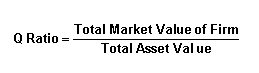
The Q ratio was devised by James Tobin of Yale University, Nobel laureate in economics, who hypothesized that the market value of a company on the stock market should be about equal to its replacement cost. The Q ratio is calculated as the market value of a company divided by the replacement value of the firm's assets:

The average Q ratio for the stock market is about 0.71. The all-time Q Ratio high at the peak of the Tech Bubble was 1.82 - which suggests the stock market price was 158% above the historic average replacement cost of 0.71. The all-time lows in 1921, 1932 and 1982 were around 0.30, which is about 57% below replacement cost. Interesting how the extremes in the Q Ratio (highs and lows) have corresponded closely to high and lows in the stock market. Of even greater interest is the reading of 0.69, which is right around the historical average of 0.71, occurred after the tremendous stock market decline in 2008/2009. One would think this number would have been much lower than 0.69 given the severity of the downturn in the market.
For example, a low Q (between 0 and 1) means that the cost to replace a firm's assets is greater than the value of its stock. This implies that the stock is undervalued. Conversely, a high Q (greater than 1) implies that a firm's stock is more expensive than the replacement cost of its assets, which implies that the stock is overvalued. This measure of stock valuation is the driving factor behind investment decisions in Tobin's model.
This method can also be applied to the stock market as a whole. It's a fairly simple concept, but time consuming to calculate for the whole market. The Q Ratio is the total price of the market divided by the replacement cost of all its companies in the market. Fortunately, the government does the work of accumulating the valuation data for the calculation. The numbers are supplied in the Federal Reserve Flow of Funds Accounts of the United States, which is released quarterly.
Below is historical chart of Q ratio using the data:

The average Q ratio for the stock market is about 0.71. The all-time Q Ratio high at the peak of the Tech Bubble was 1.82 - which suggests the stock market price was 158% above the historic average replacement cost of 0.71. The all-time lows in 1921, 1932 and 1982 were around 0.30, which is about 57% below replacement cost. Interesting how the extremes in the Q Ratio (highs and lows) have corresponded closely to high and lows in the stock market. Of even greater interest is the reading of 0.69, which is right around the historical average of 0.71, occurred after the tremendous stock market decline in 2008/2009. One would think this number would have been much lower than 0.69 given the severity of the downturn in the market.
Subscribe to:
Posts (Atom)